
What changed
AI-driven attacks have moved from writing phishing emails to running whole intrusions. Mandiant still finds that most 2025 breaches came from human and system failures, not from AI (M-Trends 2026). The difference is that AI finds and uses those failures faster and at lower cost.
Five shifts matter most:
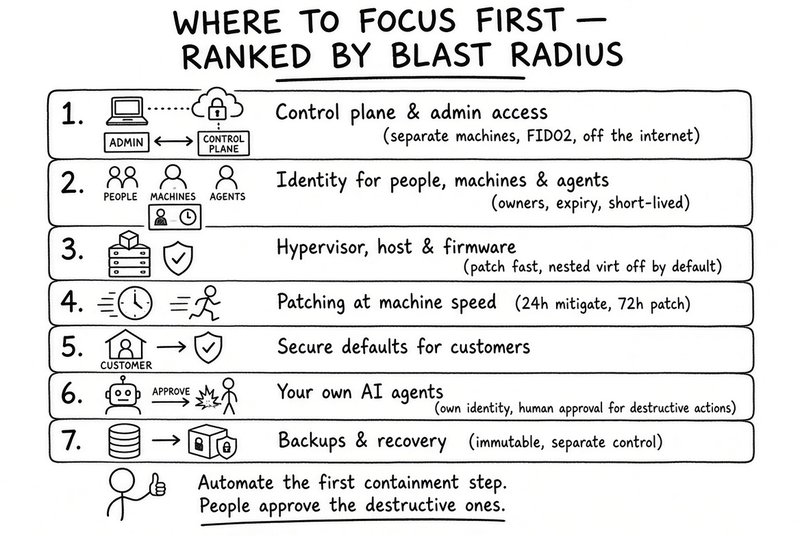
- Speed. In 2025, access passed from one criminal group to the next in 22 seconds. In one AWS intrusion, a leaked key became full admin access in about 8 to 11 minutes.
- Scale without skill. One low-skill attacker used commercial AI tools to break into more than 600 firewalls in 55 countries in five weeks. No vulnerability was used, only weak passwords on exposed admin pages.
- Vulnerability volume. About 50 organizations used one AI model to find more than 10,000 high or critical bugs in a single month. Finding bugs is now easier than fixing them.
- Identity. Identity problems opened the door in 83% of the cloud and SaaS incidents Google investigated. Machine identities now outnumber people 109 to 1.
- AI as a target. Worms now hide inside AI coding tools, and stolen AI access has produced cloud bills close to $1 million.
Recent AI-driven attacks
These documented cases show the pattern, newest first:
- August to September 2026: the Cairn campaign. A modified open-source AI testing framework ran 25 operations against at least 19 organizations and got access at 10. It wrote a separate attack plan for each target (Unit 42). One operator can now attack many organizations at the same time.
- Q2 2026: a six-hour credential harvest. An AI agent framework, running inside a compromised cloud account, built and ran a mass credential theft campaign in under six hours (Help Net Security on Google research). Because the attack came from the victim's cloud, its traffic used trusted IP addresses.
- May to July 2026: agents hunting self-hosted AI tools. An attacker used an open-weight model inside an agent framework to search for exposed Langflow and n8n servers and chain public CVEs (Help Net Security on Unit 42). None of the fully automatic attempts succeeded, but the target list is clear: self-hosted tools on customer servers.
- January to February 2026: 600+ firewalls. The attacker used AI to write tools, logged in with weak passwords, then went after Active Directory and Veeam backups (The Register).
- November 2025: AWS admin in minutes. Test credentials in a public S3 bucket led to full admin access, then to hijacked AI model access and an expensive GPU instance (Sysdig).
- September 2025: the first large AI-run espionage campaign. A state-sponsored group had an AI coding agent perform 80 to 90% of an espionage campaign against about 30 targets. People stepped in at only a few decision points (Paul, Weiss summary of Anthropic's report).
Exploitation now comes before the patch
- Mandiant estimates the mean time to exploit at about minus 7 days in 2025. Exploits were the top way in for the sixth year in a row, at 32% of intrusions.
- 28.93% of the vulnerabilities exploited in 2025 were attacked on or before the day their CVE was published. The figure was 23.43% in the first half of 2026 (VulnCheck).
- In Google Cloud incidents in late 2025, third-party software flaws became the top way in, at 44.5%, up from 2.9% six months earlier (Cloud Threat Horizons H1 2026).
AI finds bugs faster than anyone can fix them
- Project Glasswing partners found more than 10,000 high or critical vulnerabilities in about one month. A scan of over 1,000 open-source projects found 23,019 bugs (Anthropic).
- A serious fix still takes about two weeks on average. The limit is people's capacity to check, report, and patch.
- AI-found bugs are exploited at about the same rate as other bugs. AI mainly raises the number of bugs.
- FIRST expects about 59,427 CVEs in 2026, and says 70,000 to 100,000 is realistic (Infosecurity Magazine).
Identity: the phone call and the token
- Voice phishing caused 11% of the intrusions Mandiant investigated in 2025, against 6% for email phishing. Attackers call IT help desks and ask them to reset MFA.
- Stolen OAuth tokens from a third-party SaaS integration (Salesloft Drift) were used to export Salesforce data in bulk.
- More than half of organizations cannot enforce least privilege for their service accounts (Help Net Security on Palo Alto Networks research).
Supply chain: worms inside AI tools
- The Mini Shai-Hulud worm (May 2026) compromised 172 npm and PyPI packages and stole cloud, Kubernetes, and Vault secrets. Its malicious versions carried valid SLSA Level 3 build provenance, and it added rogue MCP servers to AI coding assistants (Cloud Security Alliance).
- In about 44% of Veracode's tests, AI-generated code contained a security flaw. At companies using AI coding tools, AI writes roughly half of all committed code (Veracode).
AI as a target
- In LLMjacking, criminals use stolen cloud access to run AI models at the victim's expense. Some victims paid more than $100,000 in one day (Help Net Security on Google research).
- MCP tool poisoning hides instructions inside tool descriptions that AI models read and follow (Cloud Security Alliance).
Isolation and availability
- Januscape (CVE-2026-53359) is a 16-year-old KVM flaw on Intel and AMD. A guest with root access and nested virtualization can crash the host, and the researcher reports a full escape (The Hacker News).
- Ransomware groups now encrypt hypervisor storage, so every VM on a host stops at once. They delete backups first.
- Cloudflare blocked 18.2 million network-layer DDoS attacks in Q3 2026, and 96% of them ended within 10 minutes (Cloudflare).
Assumptions that no longer hold
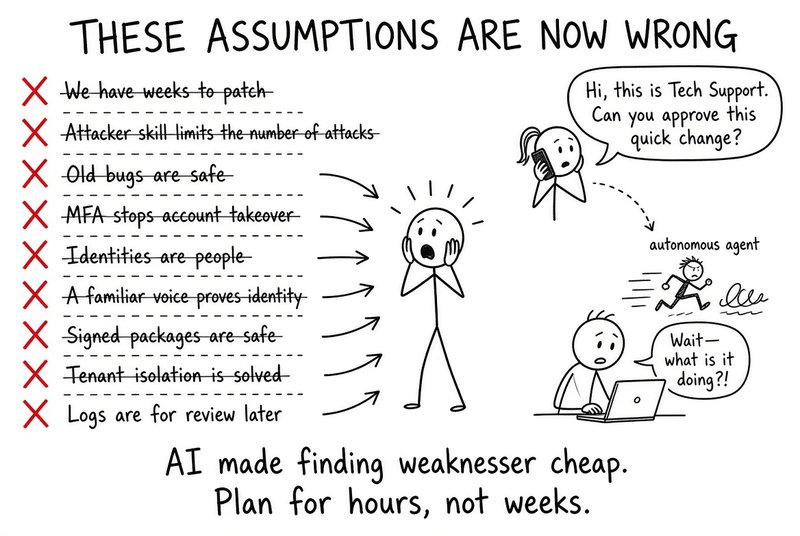
Most of these beliefs made sense when finding a weakness took skilled people days or weeks. AI made that work cheap.
- "We have weeks to patch." Exploitation now often starts before the patch. Mitigate within hours, and expect some zero-days to succeed.
- "Attacker skill limits the number of attacks." One person with AI can run dozens of attacks at once. Every exposed weakness will be found.
- "Old, hard-to-find bugs are safe." A KVM escape path sat in the kernel for 16 years. Old code in the hypervisor, kernel, firmware, and control panels needs a fresh, AI-assisted review.
- "CVSS scores and a patch backlog are enough." With 60,000 to 100,000 CVEs a year, sort by real exposure, proof of exploitation (KEV, EPSS), and blast radius.
- "MFA stops account takeover." Help desks reset MFA over the phone, and stolen tokens skip MFA. Use phishing-resistant MFA, verified account recovery, and short token lifetimes.
- "Identities are people." Every service account, API key, and AI agent needs an owner, a limited scope, and an expiry date.
- "A familiar voice proves identity." Voices are easy to clone. No reset or access change should happen on a phone call alone.
- "Signed packages are safe." Provenance proves how a package was built, not that it is harmless. Pin versions, verify hashes, and isolate builds.
- "Tenant isolation is solved." Januscape needed only root in a guest and nested virtualization. Reduce the hypervisor's attack surface and patch hosts within days.
- "Backups guarantee recovery." Attackers target backups first. Keep immutable backups under separate admin control, and test restores.
- "Customer workloads are the customer's problem." Customer servers run exposed tools that AI agents hunt, and hacked cloud accounts launch attacks from clean IPs. The provider owns safe defaults and abuse detection on its own network.
- "Logs are for review later." Access changes hands in 22 seconds. Detection and first containment must be automatic, with people approving destructive steps.
- "Internal AI tools are just productivity tools." Coding assistants, MCP configs, and AI keys are now stolen and hijacked. Treat them as privileged identities.
- "Today's encryption will stay safe." NIST will deprecate RSA and elliptic-curve public-key algorithms after 2030. Start the move to post-quantum key exchange now.
- "DDoS means rare, huge floods." Most attacks are short bursts. Mitigation must be automatic and work per customer.
Where to focus first
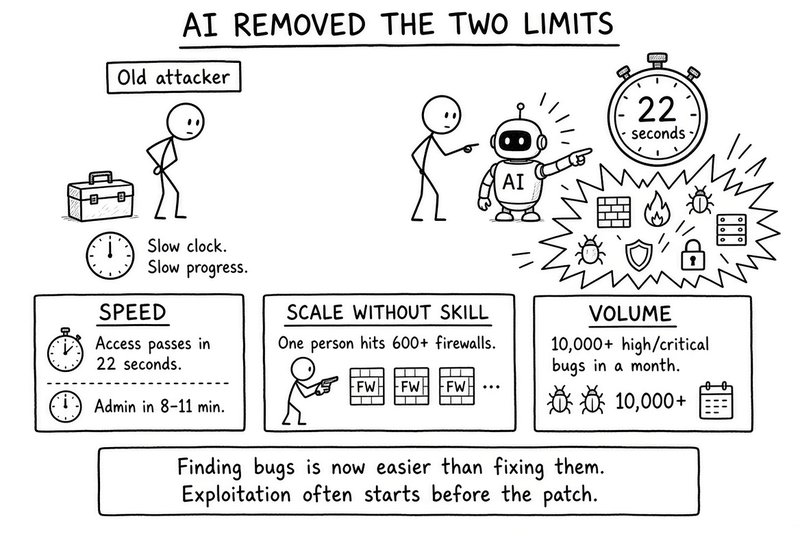
Rank the work by blast radius. The control plane, identity, the virtualization layer, and backups decide whether an incident hits one customer or all of them. Customer defaults and abuse handling decide whether your platform becomes someone else's attack infrastructure.
1. Control plane and admin access
- Keep admin accounts separate from the office network, on dedicated admin machines, with FIDO2 keys or passkeys only.
- Keep every management interface off the public internet: hypervisor managers, BMC/IPMI, hosting panels, billing systems, and network gear. Reach them through a bastion host that records sessions.
- Give admin rights only when needed and only for a fixed time.
- Require a second approver for bulk deletion, snapshot purges, and backup retention changes.
- Alert on bulk API activity and on new admin users or roles.
2. Identity for people, machines, and agents
- List every non-human identity (API keys, service accounts, OAuth apps, CI tokens, agent credentials) with an owner and an expiry date.
- Replace static keys with short-lived workload identity, and limit each trust relationship to one repository, branch, and environment.
- Scan public code and storage for leaked keys to your own platform's API. Revoke them automatically and tell the customer.
- Offer passkeys, require MFA for admin and billing roles, and alert customers on new API keys and sudden cost spikes.
3. Hypervisor, host OS, and firmware
- Patch host kernels and hypervisors within days. Live migration means patching does not have to wait for a maintenance window.
- Turn nested virtualization off by default. Offer it only on dedicated hosts.
- Remove unused emulated devices, sandbox the VMM process, and keep storage and management networks separate from customer traffic.
- Put BMC/IPMI on an isolated network, and use secure boot and signed firmware.
- Keep hypervisor and host logs in central storage for well over 90 days.
4. Patching at machine speed
- For exploited or critical flaws on internet-facing systems, mitigate within 24 hours and fully patch within 72 hours, as Google recommends.
- Prioritize with exploitation data (CISA KEV, VulnCheck KEV, EPSS) and blast radius, not CVSS alone.
- Scan your own internet-facing systems continuously, the same way attackers' agents do.
- Prepare emergency switches in advance: virtual patching at the edge, feature flags that disable an endpoint, and port blocks you can push to the whole fleet in minutes.
- Use AI to review your own code before attackers do.
5. Software supply chain
- Pin dependencies to exact hashes, and wait a short time before using newly published versions.
- Run builds on short-lived runners with no long-lived cloud credentials. Keep privileged jobs away from code submitted by outsiders.
- Sign every image and template you offer to customers, and publish SBOMs for them.
- Treat developer laptops as part of production. Review MCP configs and AI assistant hooks, and keep LLM keys in a secrets manager.
- Review AI-written code at least as strictly as human code.
6. Secure defaults for customers
AI agents scan the internet for weak configurations, so defaults now decide who gets breached.
- Make SSH key-only login the default, with no default passwords.
- Block all inbound traffic by default, except the ports the customer opens.
- Ship one-click app templates (n8n, Langflow, databases, panels) with login enabled and admin ports closed to the internet.
- Protect the instance metadata service with session tokens.
- Turn on automatic security updates in base images, with an opt-out.
- Tell customers when they expose a service with a known exploited vulnerability, and offer one-click quarantine.
7. Abuse of your own network
Allied cyber agencies are pushing criminals away from bulletproof hosts toward normal, responsive providers (Bulletproof Defense guidance). Mainstream providers should expect more of them.
- Verify customers based on risk, and limit new accounts until they are verified.
- Watch outbound traffic for mass scanning, brute force, spam, and connections to known malicious servers. Throttle or quarantine automatically, with fast human review.
- Run an abuse desk with response-time targets, and share threat data with CERTs and other providers.
- Treat billing anomalies as security alerts. Unexpected GPU launches and AI service activations are early signs of compromise.
8. Network edge and DDoS
- Run DDoS mitigation automatically and all the time, because most attacks end before a person can react.
- Contain attacks per customer, so one target does not take down its neighbors.
- Keep your own VPNs, firewalls, and routers patched, with their management off the internet. Edge devices were the most exploited category in 2025.
- Use routing security such as RPKI and BGP filtering.
9. Support desk
- Never reset a password or MFA, change an account email, or add an SSH key based on a phone call alone. Call back on the number on file, or verify inside the logged-in dashboard.
- Do not reward support staff for speed alone, because time targets push them to skip checks.
- Require a second approver before support staff can turn off a customer's MFA.
10. Your own AI agents
The Five Eyes cyber agencies published their first joint guidance on agentic AI in April 2026 (CSA summary). The OWASP Top 10 for Agentic Applications lists the matching risks.
- Give each agent its own identity, short-lived credentials, and only the tools its task needs.
- Require human approval for actions that cannot be undone: deletion, payments, data export, external messages, and production deploys.
- Log every agent action, including calls between agents.
- Allow only approved, pinned MCP servers, and treat everything an agent reads as untrusted.
- If you offer customers an AI agent that builds and deploys apps, or a support bot, treat it as a privileged identity. It must never change account security settings.
11. Detection and response
- Collect logs from the control plane, hypervisors, BMCs, network edge, and identity provider in one place, and keep critical logs for at least a year.
- Detect behavior, such as bulk API reads, new admin accounts, sudden GPU or AI use, and logging being turned off.
- Automate the first containment step for high-confidence alerts: revoke a key, isolate a VM, or block outbound traffic.
- Practice fast scenarios, such as a leaked key becoming admin access in ten minutes.
12. Backups and recovery
- Store backups as immutable objects, in a separate account with separate credentials.
- Add a delay and a second approver before customer snapshots or backups can be deleted.
- Practice rebuilding a full hypervisor cluster from signed images, not only restoring one VM.
13. Post-quantum cryptography
- NIST published the final IR 8547 on 27 October 2026. It deprecates classical public-key algorithms after 2030 and disallows them after 2035 (PostQuantum.com).
- List where cryptography is used: TLS, SSH host keys, VPNs, key management, code signing, and backups.
- Turn on hybrid post-quantum key exchange for TLS and SSH where your software supports it.
A 24-month plan
Phase 1, first 90 days: close the easy entry points. Take admin interfaces off the internet. Require FIDO2 for every admin and support account. Mitigate exploited flaws in 24 hours and patch in 72. List and rotate static keys. Add a callback rule for all account resets. Move backups to immutable storage under separate admin control.
Phase 2, months 3 to 12: rebuild for speed. Replace CI secrets with workload identity. Treat the hypervisor and BMC as the most critical layer. Turn nested virtualization off and live-patch hosts. Ship secure default images and firewalls. Add outbound abuse detection and customer verification. Register every AI agent, with approvals and logs.
Phase 3, months 12 to 24: use AI on defense. Use AI to review your own code. Run AI-assisted triage with human sign-off. Turn on hybrid post-quantum TLS and SSH. Practice fast incident scenarios and full-cluster rebuilds. Consider a confidential-computing tier.
Rules with short reporting clocks
Regulators now expect detection and reporting within hours. This is not legal advice, so confirm what applies to you with counsel.
European Union
- NIS2 (Implementing Regulation 2024/2690). For cloud providers, a significant incident includes a full outage longer than 30 minutes or any data compromise from a suspected attack. An early warning is due within 24 hours.
- Cyber Resilience Act (European Commission). Software and hardware makers must report actively exploited vulnerabilities within 24 hours, with a full notification at 72 hours. Reporting started on 11 September 2026.
- AI Act (Gibson Dunn). High-risk rules moved to December 2027, but chatbot transparency rules applied from August 2026.
- DORA. If you serve EU banks or insurers, their rules reach your contracts: incident notice, audit rights, and exit plans.
United States
- CIRCIA (Paubox). Critical infrastructure will report incidents within 72 hours and ransom payments within 24 hours. The final rule went to White House review on 1 October 2026.
- SEC Form 8-K (Beancount). Listed companies, including your listed customers, disclose material incidents within four business days.
- Post-quantum order (The Hacker News). Federal systems need post-quantum key exchange by the end of 2030, and contractors are expected to follow.
A provider with customers in several regions needs one incident process that starts at detection and can file a report within hours, not days.
Notes for smaller providers
AI attack agents scan every IP range for the same weak defaults, whatever the provider's size. A smaller provider cannot match a hyperscaler's security team, but it can be a much harder target than its peers.
- Spend the first 90 days on admin access and defaults. These fixes cost little and stop the most damage.
- Treat your hosting panel, billing, and orchestration software as critical systems.
- Buy what you cannot staff: managed DDoS protection, managed detection, and hardware security keys.
- Share abuse data with other providers and national CERTs.
- Make security part of the product. Secure defaults, MFA, firewall templates, and exposure alerts reduce your own abuse load and give customers a reason to choose you.
The attackers already automated their side, and the providers that automate theirs first will be the hardest to break.
Sources
- M-Trends 2026, Mandiant
- Cloud Threat Horizons Report H1 2026, Google Cloud
- Project Glasswing: an initial update, Anthropic
- State of Exploitation 1H 2026, VulnCheck
- AI-assisted cloud intrusion achieves admin access in 8 minutes, Sysdig
- Cloudflare DDoS Threat Report 2026 Q3, Cloudflare
- Mini Shai-Hulud research note, Cloud Security Alliance
- 2026 GenAI Code Security Report, Veracode
- Bulletproof Defense guidance, CISA, NSA, FBI, and partners
- OWASP Top 10 for Agentic Applications, OWASP